
Your amazing idea needs funding. We help you get it.
We help you shape the idea and choose the call that fits it. Together we find the partners your consortium is still missing, and then we write the project proposal.
- Track record
- 56% success rate 3.5× the EU average
- Programmes
- Horizon Europe, EDF and national programmes
- Who we work for
- Organisations in the EU and EEA and in Australia, Canada, Japan and New Zealand
Each idea has its lifecycle. In which stage are you?
We also work with you after the grant is won. Public money comes with obligations such as reporting, and we have the software and the know-how to help you meet them.
-
01
Data points
We read what the EU has just funded to see what it is likely to fund next.
Funding intelligence -
02
The call
Hundreds of calls are open. We find the one that fits your idea and advise you when to apply.
Funding intelligence -
03
Carefully crafted proposal concept
We shape the idea to answer the call and build the consortium around it.
Proposal system -
04
Above the threshold
Seal-of-Excellence quality for every proposal we write.
Expert team -
05
Funded
Before you sign the grant agreement, we help you bring the consortium agreement in line with it.
Expert team -
06
Implementation
From the first day of the project, our software keeps the records for reporting.
Platform -
07
Results into use
We help you get the project's results adopted.
Expert team
Before we write, we check that the idea and the core consortium match the call. Then we set out the intervention logic, which shows how the project will deliver the results the call expects. The proposals our experts have led for Horizon Europe, the European Defence Fund and national programmes have a 56% success rate, about three and a half times the EU average.
Funding intelligence
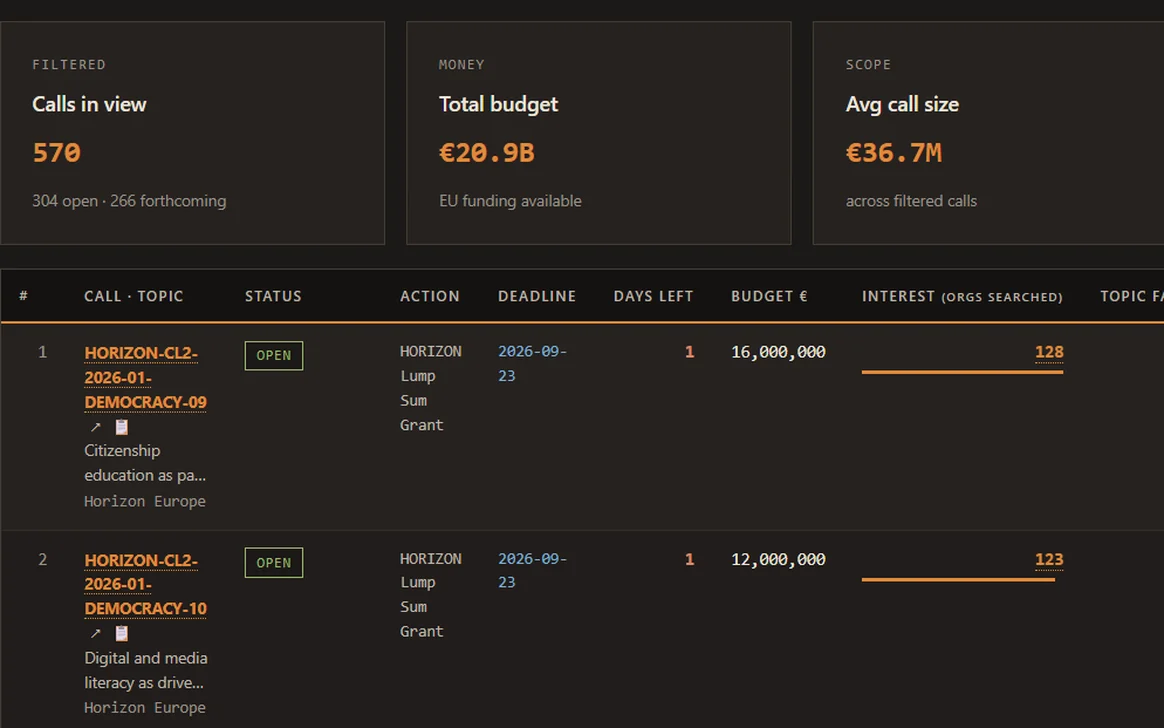
We keep our own up-to-date database of EU funding and use it for every client. It holds the open calls with their binding conditions. It groups the deadlines so that you can plan a year of proposals. Horizon Europe funds roughly one proposal in seven, and our database shows where the others fall short. We also see which organisations won which projects and who their partners were.
Consortium modelling
To shortlist partners, we look at what each candidate has published and which projects it has won. We also look at how the consortia that won earlier calls of the same kind were put together. We make no prediction about who will win. From several thousand candidates we bring you a short list of those worth a conversation, with the reason for each name.
The proposal system
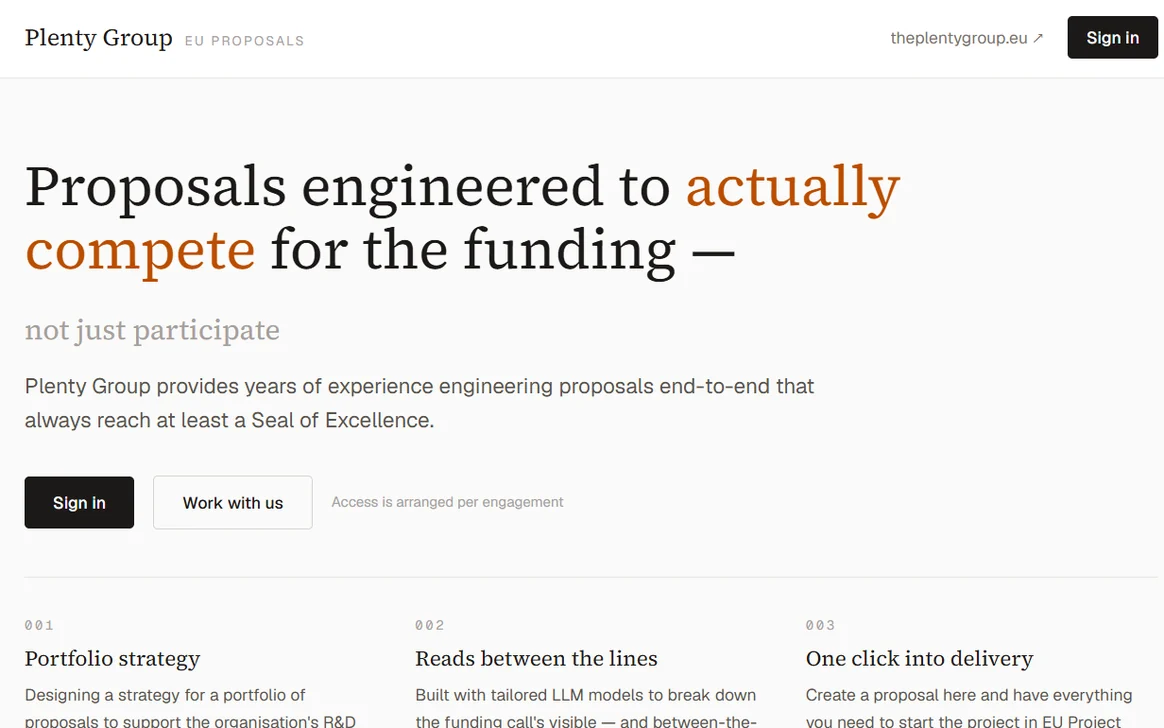
The proposal is built in our own software. Its structure follows the call's binding conditions. When the work plan changes, the effort and the budget change with it, so the budget cannot contradict the work plan and cost you points.
We celebrate wins. We make sure we can celebrate implementation as well.
Open the platform ↗ Talk to usWe want the projects we helped win to be run well. So we support you in the years after the award. You get our software for running the project.
Pleno
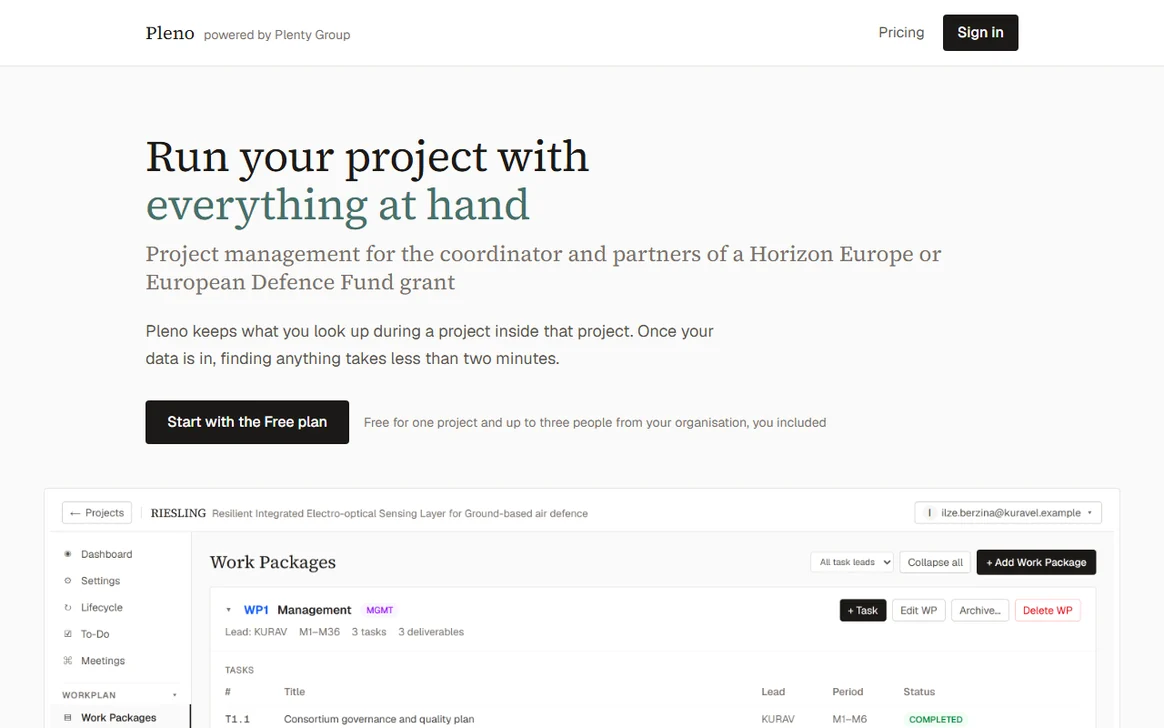
Pleno is our own software for running a funded project. It holds the partners, the work packages, the deliverables and the milestones. You plan the effort in it and, for actual-cost grants, it keeps the evidence behind the personnel costs of each reporting period. Our clients get it as part of our work with them. It is also available on its own. Open Pleno ↗
Plenty Nexus
Plenty Nexus is a registered NGO we work alongside. It is a think tank for the long-term development of the European Union. In EU-funded research and innovation projects, it can take part as a beneficiary and contribute its own expertise.
After a project ends, there is little time to act on its results. Getting them adopted is a separate job, which we do best on projects whose proposal we also shaped.
Into practice
We run the pilots with you and hand the result over to the organisation that will keep using it after the funding stops. We want that organisation to build it into its operations, a product or its daily practice, and to have the evidence to justify keeping it.
Uptake and lobby
We make the case for your result to the people who can act on it. We write the briefings and hold the meetings needed to get it into policy or a standard, and sometimes into the next round of funding.
Route and rights
You can sell a result yourself, license it, start a company around it or offer it for dual use. We help you choose the route that fits the result and your organisation, and we make sure you hold the ownership and access rights it requires.

Chance favours only the prepared mind.
Proposals are set on the winning trajectory.
We start in the first weeks of a proposal, before anyone writes. Those weeks largely decide the result, because that is when the call is chosen, the consortium is formed and the idea is framed against the award criteria.
We take on a few clients at a time. We stay with each of them through the whole lifecycle, up to the commercialisation of the results. Over those years we learn how each client's organisation works.
- L1
The call
Many well-written proposals fail because the call did not match the idea.
- L2
The consortium
Evaluators read the list of partners as evidence that the work can be done.
- L3
The argument
We write every section against the award criterion it is scored on.
Engagements
Proposal writing
We write the full proposal for EU funding calls, including Part B, the work packages, the presentation of the consortium and the budget, and we stay until it is ready to submit.
Opportunity identification
We help you decide which funding calls, partnership offers and other openings to pursue and when. They arrive faster than most organisations can keep up with. We judge each one by how well it fits your organisation's plans.
Strategic advisory
Over a longer period, we work with you on decisions about your organisation's positioning, capital structure and governance, and on dual-use questions. You pay for help with these decisions and judge our work by them.

Your government may pay towards the writing.
In five of these seven Baltic Sea countries, the state pays towards preparing a Horizon Europe proposal. Finland closed its grant in November 2025 and Lithuania in February 2026. The rules differ by country, and most of them change from year to year. Choose your country to see what applies.
Sweden · Vinnova
Up to €45,000
SEK 500,000 for the coordinator of an international project.
Up to €27,000
SEK 300,000 for a partner.
Vinnova's planning grant pays at most 80% of the cost of preparing a proposal. Forte, a Swedish research council, co-funds it. A consultant's fee for help with the writing counts as a cost, up to SEK 75,000 (about €7,000). SMEs, universities, research institutes, the public sector and civil society organisations in Sweden can apply. Large companies are not on the list. The grant covers Horizon Europe and other Commission programmes, such as LIFE and Digital Europe. In Horizon Europe's first pillar, Excellent Science, only MSCA Doctoral Networks, MSCA COFUND and ERC Synergy count. The grant pays for the preparation itself, so the EU result does not matter. The 2026 rounds closed on 21 April and 6 October, and we have not yet found dates for 2027. Vinnova's planning grant (in Swedish) ↗
Poland · Polish Agency for Enterprise Development (PARP) and the Ministry of Science
Up to €26,000
For an SME, as one fixed sum that depends on its role. The top sum, PLN 114,842, is for an SME that applies alone and needs specialist analyses.
Up to €14,000
For a research organisation, PLN 62,492 at most, as a coordinator or work-package leader with specialist analyses.
€3.4 million
PLN 15 million, the budget of PARP's next round. It is planned to open on 19 November 2026 and close on 31 March 2027.
PARP's scheme, Granty na Eurogranty, covers partner search, writing, translation and specialist analyses for Horizon Europe and nine other EU programmes, among them Digital Europe, LIFE and the Innovation Fund. SMEs and research organisations based in Poland can apply, but large companies cannot. You apply to PARP before you submit to the EU. PARP pays after the EU evaluation, and only if the proposal scores above 50% of the maximum points. No invoices are needed. Universities and research institutes can also ask the Ministry of Science and Higher Education to refund some of their costs for preparing a Horizon Europe or Euratom proposal, such as staff bonuses and contracts for specific work. The ministry pays up to PLN 30,000 (about €6,800) to a consortium coordinator and PLN 40,000 (about €9,100) to the institution that would host an ERC grant, if the proposal reaches the threshold. ERC proposals count, but individual MSCA fellowships do not. The ministry counts costs from the 12 months before you submit, and it takes claims all year. PARP's next round (in Polish) ↗
Denmark · Danish Agency for Higher Education and Science
Up to €20,000
DKK 150,000 for the coordinator.
Up to €10,000
DKK 75,000 for a partner or a single applicant.
EUopSTART pays up to half of the cost of preparing a Horizon Europe proposal, including an external consultant's fee. Your organisation must apply itself, even if a consultant helps with the writing. Companies and approved technological service institutes based in Denmark can apply. Universities cannot. It covers only the parts of Horizon Europe its call lists, so not the ERC's individual grants or Widening. A coordinator gets at most DKK 75,000 (about €10,000) for ERC Synergy, COST, EIC, Eurostars or the first stage of a two-stage call, and a COST partner gets nothing. You have to apply at least 30 days before the EU deadline. The grants are competitive. You are paid after you submit the proposal and the agency approves your final report. The EU must find the proposal admissible and eligible, but its score does not matter. The 2026 rounds have passed, and the 2027 dates are expected by the end of 2026. EUopSTART ↗
Latvia · Investment and Development Agency (LIAA) and the Latvian Council of Science
Up to €15,000
For a company, from LIAA. It repays half of the costs. A company can receive no more than €15,000 in total, however many proposals it prepares.
€13,000
For a research organisation that coordinates a consortium proposal above the threshold. A partner, or one that applies alone, gets €7,000.
Up to €5,000
For a foreign expert's review of a proposal that a Latvian research institution coordinates. The Latvian Council of Science pays it only if the proposal scores above the threshold.
LIAA's support covers Horizon Europe, Digital Europe, the Innovation Fund and other programmes the Commission runs centrally. The project must fit one of the priority areas in Latvia's smart specialisation strategy. SMEs can apply, and larger companies too if they work with SMEs. Staff time, travel and outsourced services count as costs, from the day you apply to LIAA until you submit to the EU. LIAA decides on your application within a month. It pays after the EU result, for example if the proposal is funded, passes a stage or receives a Seal of Excellence. The scheme runs until 31 August 2029, while the money lasts. LIAA's support (rules in Latvian) ↗
The 14 universities and research institutes named in Cabinet Regulation 502 receive these sums for each proposal that scores at or above the threshold, through a measure under the Ministry of Education and Science. The Latvian Council of Science pays the same sums to research associations and foundations from a small fund, planned for 3 coordinators and 12 partners. Its expert review is for calls such as Pillar 2 clusters and missions, Teaming, Twinning and MSCA Doctoral Networks, but not for the ERC or the EIC. You apply for it at least four weeks before the EU deadline. The Council can also pay up to €75,000 to improve an ERC proposal that scored above the threshold but was not funded. The Council's support for associations (in Latvian) ↗
Estonia · Estonian Research Council (ETAG)
€7,000
For the coordinator of a Horizon Europe or COST proposal. ERC applicants who reach the second round get the same, as do ERA Chair applicants.
€4,000
For a single applicant in any other individual project.
+€1,000
For a coordinator whose consortium includes a partner from Latvia or Lithuania.
ETAG pays a fixed sum after the EU evaluation, and only for a proposal above the threshold. The money can cover the costs of preparing and writing the proposal. EU partnership calls are not covered. The coordinator or single applicant claims it. It can be any organisation registered in Estonia with an Estonian bank account, such as a university, a company, a municipality or an NGO. Partners cannot claim, except one Estonian partner when a Ukrainian institution coordinates. A coordinator with a partner from Ukraine gets €7,000 more, for evaluation results issued from 2026. Claims are due within six months of the result, and ETAG pays within 30 days. It also pays an ERC applicant's mentor up to €500. ETAG's preparation grant (in Estonian) ↗
Finland · Business Finland
Finland's preparation grant has been closed since November 2025.
Business Finland paid companies 75% of the cost of preparing a large Horizon Europe proposal, up to €60,000, if the proposal scored at least 3 on each criterion. It closed that call on 10 November 2025, after cuts to innovation funding in the state budget, and has given no date for reopening. A company can still include the search for Horizon Europe partners in a Business Finland research and development project, but not the writing. We found no national scheme for research organisations, and the Helsinki-Uusimaa regional grant of up to €30,000 has ended. Business Finland's news of 8 September 2025 ↗
Lithuania · Ministry of Education, Science and Sport
Lithuania's preparation grant closed in February 2026.
Between August 2023 and February 2026, the ministry paid for consultants who helped prepare a Horizon Europe proposal. A Lithuanian coordinator or single applicant could get up to €20,000, and a partner up to €10,000. In both cases the sum could be no more than 10% of the EU grant the organisation asked for. Universities, research institutes and companies could all claim. It was paid only for a proposal the Commission found admissible and eligible and sent to evaluation, and the rules set no minimum score. We have found no successor call. The National Contact Points at the Research Council of Lithuania advise and read drafts for free. The closed call (in Lithuanian) ↗
We check these rules again for every new call. Euro amounts for Sweden, Denmark and Poland are rounded, at the European Central Bank's rates of 9 November 2026.
Where our experts are the best.
Sectors
Health & life sciences
Diagnostics, digital health, pharmacy and nutrition.
Energy & climate
Energy systems, storage and the climate transition.
Water & the environment
Water and wastewater, and the blue economy.
Digital & industry
ICT, digital innovation hubs and manufacturing.
Also active in mobility, agrifood, social inclusion, education and the public sector.
Signature strengths
Widening
We know how evaluators read proposals for Twinning, Teaming and Excellence Hubs, three of the instruments the EU built to raise research and innovation capacity in Widening countries. Evaluators look at the logic of the partnership, the long-term commitment of the institutions and the case for excellence.
Business ecosystems
We map a region's clusters and the networks between its companies and public bodies. We bring their members together and run business exchange, mentoring and acceleration programmes for them.
Defence & dual-use
Our newest practice is for companies whose products or research could be used in defence. We first check whether defence makes sense for you. If it does, we help with the business strategy and the EDF and EDIP proposals, and we find you a place in a consortium.
The defence practiceWhat we do
Before the proposal is written, we work with you on the idea, the call and the consortium. Then we write it in our proposal software. If your organisation needs it, we design a funding strategy that says which programmes to apply to over the coming years and in what order.
Once the grant agreement is signed, the project runs on Pleno, our project management software.
We help you take a result to market or build it into an organisation's operations. We test the business model against the Four Fits of market, channel, model and scale, and we settle intellectual property and access rights early. When a venture is ready to grow, we add acceleration support.
Plenty Group works with research organisations, public-interest institutions and early-stage ventures, and with initiatives that sit between them. Each of them has an idea that answers a need in society.

Plenty Group works closely with Plenty Nexus.
Plenty Group
Plenty Group is a company you hire. It helps you get an idea funded and run the project. It also helps turn the results into business.

Plenty Nexus
Plenty Nexus is a registered NGO. It studies what regions and industries need and joins projects as a partner.
plentynexus.com ↗Tell us where you are.
You can also write to info@theplentygroup.eu. Our privacy notice explains how we handle what you send.